Cyborg's righteous father finally couldn't bear it
Codex users shouted "Tibo" for nearly a year, and there was a louder title "Cyborg Father" on the Chinese Internet.
He is the core leader of Codex, the OpenAI programming tool, also known as the “God of Reset,” with the informal title of CRO (Chief Reset Officer).
As soon as the quota was used up, the user rushed to the comment area to brush the "Father-in-law reset", he was in a good mood and really filled the quota. A token-based company raised a father-in-law who insisted on "free gift".
The highlight is OpenAI DevDay in 2026. CEO Sam Altman pronounces his name, and “Tibo,” in a hoodie, stands up from under the stage, holding up the physical “reset button.” “3, 2, 1” At the end of the countdown, he holds the button and a woman next to him presses it for him. The whole audience cheered.
Then, at the end of October, the "stepfather" suddenly did not reset.
On October 31, OpenAI announced that the quota between ChatGPT and Codex is interoperable and uniformly measured by token. Compared to rival Anthropic, the appeal of OpenAI has suddenly diminished.
Four days later, the person who took the user's feedback was replaced by Andrew Ambrosino, the head of the Codex desktop, in what the media called a “handover ceremony.”
On the same day, Claude Code Product Lead Cat Wu (full name Catherine Wu) announced his departure and joined OpenAI the next day.
What Cat Wu specifically does at Anthropic, I guess I don't need to say more... (Okay, I'm afraid you don't know, let me tell you: Cat Wu is mainly responsible for Claude Code products, but during his tenure, he also cooperated with some access control "measures". In the Chinese AI culture circle, there is a nickname of "Queen of Titles")
With the arrival of Cat Wu, the news that Codex was about to be blocked on a large scale began to viral on social media.
People are afraid of being famous, pigs are afraid of being strong, hey.
Tibo changed jobs and Cat Wu joined the company. In fact, behind OpenAI's hashrate anxiety: OpenAI has to figure out who pays for each call.
If you consider that Anthropic can only be more anxious this year with Claud's rapid splitting of paid enterprise users: there is a dilemma of insufficient computing power inside, and there is a strong splitting of Claud and DeepSeek in the "higher net worth scenario". (Refer to Figures 03 and 04 below for highlights)
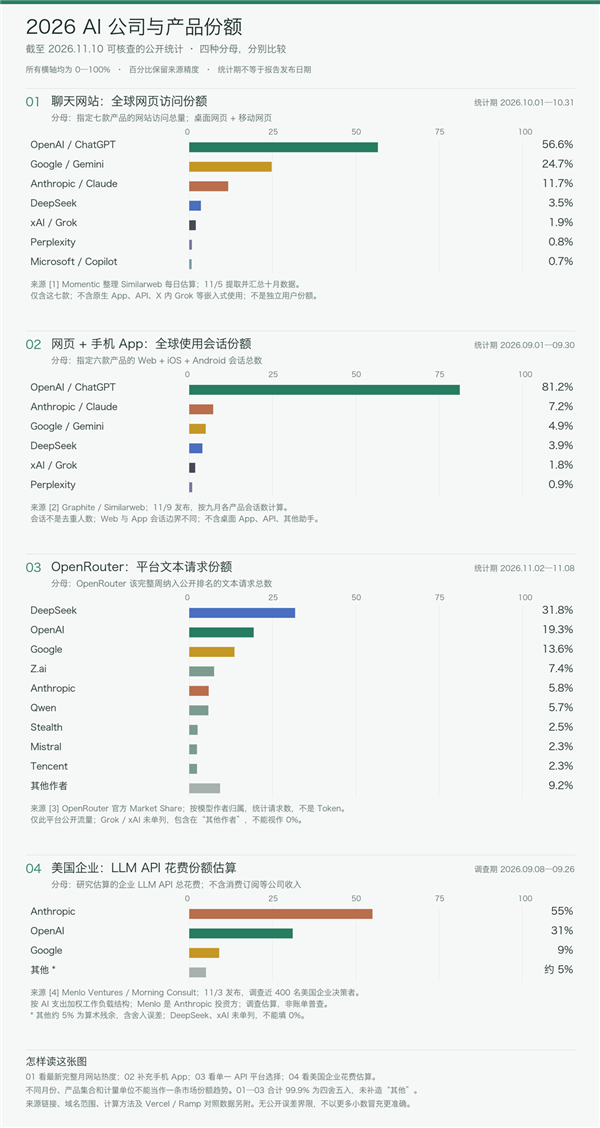
To some extent, the "job change" of "Cyborg father" Tibo is only a microcosm of the big wave - when he holds the reset key, it is the era when OpenAI tries to seize "high price sensitive users" through cost-effective, low-cost, high-frequency resets; when he exits the stage, it is OpenAI that faces lack of computing power, IPO pressure, and has to face the core battlefield with Anthropic - those high-net-worth users who are more willing to use expensive models and are more willing to pay.
It was never him who sent the money, it was OpenAI
Tibo, whose real name is Thibault Sottiaux, joined OpenAI in 2024. Previously, he spent several years at Google, where he worked on Google Maps and DeepMind's machine learning infrastructure.
In May 2026, after integrating the product team, Greg Brockman, President of OpenAI, assumed the role of Head of Core Products and Platforms at OpenAI, taking over the entire Core Products and Platforms division. ChatGPT, Codex, API platform, enterprise products, all under his name.
He was very pleasant, because his style was grounded, a little (smirking) like (laughing), and quite generous (or else people could be stepfathers).
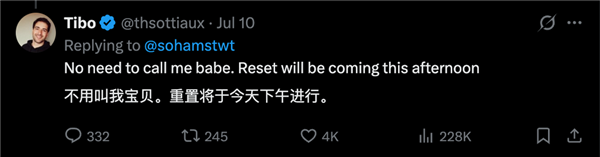
On October 5, "Tibo" issued a 28-day "military order", each day either handing over a perceived improvement or resetting it in full. The rules are simple, just like the coupon compensation when the takeaway is late, but this time you can't hand over the item and lose the amount.
As a result, in 28 days, 14 days were reset, and the whole network followed the carnival. The user gave the company the nickname “The Reset Company”. "Tibo" recognized and wrote in the farewell message, "We graduated from the reset company and upgraded to Token Company."
Image source: Social media screenshots

This "military order" was executed very seriously. On day 2, he delivered four updates, free and unlimited automatic code review, reduced API billing from 5 to 3, public beta of the macOS conferencing plugin, and a faster Decisions API. The user voted that night, and the result still asked for a reset, and he did it.
On the 15th day, the official released a "Cooking with Codex" video, which was turned into a promotional video. He made up a full reset on the spot. At this point, resetting has become an apology.
The most expensive day is Day 25. He doubled the amount of Pro 100/200/500 and Business Premium directly, and withdrew the internal plan to reduce Pro 200. It's like exchanging credits for word of mouth.
Image source: Social media screenshots
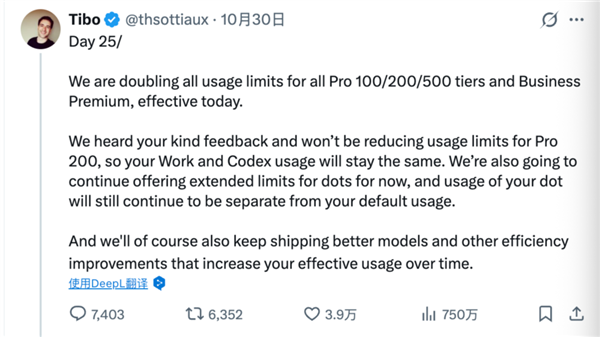
On the 27th and 28th days, he issued two reset coupons that could be saved and activated after the same amount was used up.
The comment section calls this "father-in-law playing with money." He is probably the only KPI for all OpenAIs that includes “making users happy.”
The dispersal of wealth was also quite ritualistic. In a podcast interview, he personally said that there was indeed a physical button on the desk that really triggered Codex's quota reset.
"Tibo", who was born as an engineer, does the most "operational" work of the whole company. Because OpenAI does not lack traffic, what is missing is a person who can stand in the comment area to send out subsidies and let users read well.
A former Silicon Valley senior engineer told Hu Sni that the model company ultimately spells out the model, and the product owner is important, but not irreplaceable. Interfaces and interaction paths can be observed and reproduced, and model capabilities, training, and usage data are difficult to reproduce.
The product makes sense, the marketing is just the opposite. For more than a dozen months, "Tibo" packaged the company's heaviest subsidy into a personal relationship between the user and him. The user does not recognize the list of features of Codex, but the father-in-law who will respond to comments.
Thinking of “Tibo” as a funny “community operation” or even a mascot is a misunderstanding. He mingled with users on social media platforms all day, seemingly playing with them, but he was actually doing something that the model company could not get around.
The model iterates quickly, many things in the product have been changing, and users need a communication channel. The emergence of "Tibo" provides the most direct and effective channel for this communication.
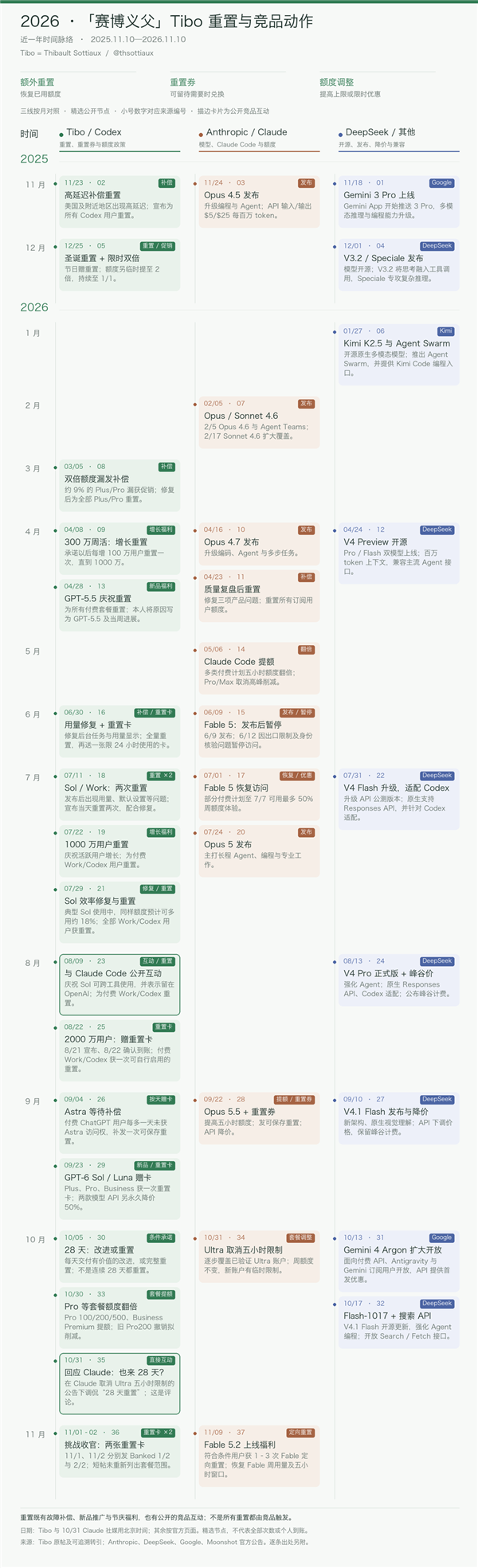
But the most essential thing is to start from the first half of the year: Claude began to grab OpenAI's share on a large scale.
JetBrains' survey of more than 15,000 professional developers showed that only 18% of respondents used Claude Code at work in January, rising to 39% in the May-July round and 47% in the United States; Codex rose from 3% to 16% over the same period. Both are rising, but the gap has not narrowed, but has increased from 15 percentage points to 23 percentage points.
Greg Brockman later admitted at a public event that the company had been “pretty tough” in the first half of the year and hadn't even been on the table in the AI programming market, “We have Codex, but nobody talks about it.”
OpenAI's response is more direct: price wars - lower thresholds, more resets.
Tibo's 28-day Warrant is a personified version of this strategy. Use a humane shell to distribute the subsidy to price-sensitive users and pull them from Claude's side.
On Day 3, the new version of GPT-6 was made available to ChatGPT's 1.2 billion weekly active users, with Codex and ChatGPT Work collectively reaching 40 million active users.
So those 14 resets were a head-on charge for OpenAI in the face of the Anthropic shock. The purpose of Tibo is to make it look less like a price war.
Changing people and titles is actually the same thing
The premise of affordable price wars is that computing power can be burned. The turning point occurred at the end of September and the beginning of October.
Xiao Li (a pseudonym), an individual developer who has worked in large domestic factories, told Hu Snan that after the high-thinking-level reasoning model was launched, a single task had to do more rounds of reasoning and call more tools, and the single computing power increased with it. During the same period, the number of users was still expanding, the supply was tightened, the product became slower, and the stability was not as good as before.
This explanation may not be official, but he explained the mechanism clearly. The more the model can solve complex problems, the more developers are willing to give it more heavy tasks. The better the product, the sooner it hits the boundaries of supply and cost.
At the same time, OpenAI also has two places to feed computing power: the development of GPT-6, and the timely response of high-end paid users. That's all the hashing power, and it can only be saved from low-cost users.
So the series of movements that began in mid-September was actually a push by the same hand.
On September 14, "Tibo" announced the retirement of the GPT-5.3-Codex-Spark for speed optimization, but no one used it. The reason given by "Tibo" is that the usage has declined and there are better models. The model was launched as a research preview on February 12 with a lifecycle of only about 7 months.
On September 29, OpenAI cut a round of credits. The third party converted at the API price and the equivalent amount of the $200 Pro tier dropped from about $14,000 to $7,000, although this was still 35 times the monthly fee, but the amount was actually shortened.
On October 31, OpenAI announced that the three quota interoperability and unified measurement by token, and those "free channels" that did not consume quotas on the web terminal in the past were merged into the same account.
Then there was ghosting, where a large number of accounts were deactivated on or around November 7 without an email warning.
There are two types of knives. One is the low-priced package number purchased through agents in low-priced areas such as the Philippines and the Middle East; the other is the number opened by one person and shared by four or five friends across platforms and regions. Those high-net-worth users who honestly bought Pro at their own expense basically did not move this round.
There was a wail on the Chinese social network, and Cat Wu, who had just joined the company, was ridiculed for "bringing Anthropic's ancestral title art". There is no official explanation, but the more substantial background in time is the new round of restrictions launched around November 2.
Image source: Social media screenshots
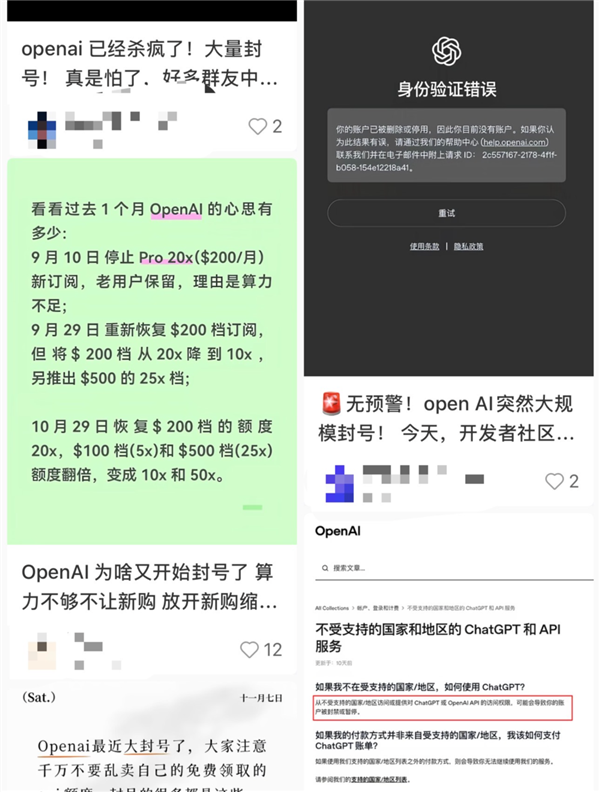
The new person in charge receives user feedback, Cat Wu joins the company, the "father-in-law" retreats behind the scenes, and the title tide falls, all in the same week.
In August, Tibo moved about a quarter of its production engineers to strengthen its security infrastructure and then took over internal security projects.
OpenAI can't bear the price war - the only computing power is to take it back from low-priced users and concentrate it on high-end products to fight Claude to the death.
It's not “Tibo” challenging Claude for 28 days, it's OpenAI competing with Claude in a new way.
The most iconic "symbol" of the old strategy can only be removed first.
Inverted ledger
The subscription of Codex is a fixed monthly fee, but the inference cost increases linearly according to the number of tokens.
Putting these two things together, the inverted hanging is almost structural. Light users may make the company more than necessary, and heavy users who invoke complex models at high frequencies are worth far more than the subscription fee.
The aforementioned senior engineer's actual test makes this account more intuitive. The subscription fee of $200 can pry the equivalent amount of API into the order of $10,000. This is not official data, but the magnitude is clear.
Users can vote with their feet at any time. Switch to Claude Code, use both sides, or immediately switch when a task is unsatisfactory.
In August 2026, market research firm TickerTrends estimated that Claude Code had an annualized revenue run rate of about $15.1 billion and Codex of about $8.8 billion, which is about 1.71 times that of the latter. This is not audited product revenue.
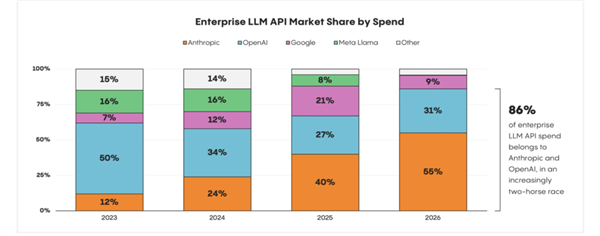
In November 2026, Anthropic investor Menlo Ventures released a report showing that Anthropic's share of the enterprise API market rose from 40% to 55%, and OpenAI rose from 27% to 31%.
Credit: Menlo Ventures
Anthropic doesn't just play cheap. Claude Sonnet 5.5 is the same price as the previous generation, and it is officially said that it can usually do the same work with fewer tokens, and the cost of most tasks can be reduced by up to 30%. This is the cost of replacing efficiency improvements with single tasks, and it is not a price reduction in the ordinary sense.
Xiao Li told Hu Sniffer that some programmers around him knew that Claude Code had a risk of being titled, and the most enthusiastic discussion was still how to use it steadily. Anthropic's list of service areas does not yet include mainland China.
He also said that the migration cost of switching to another model is often not that high. What really settles down is the code, the documentation and the development results, not the “thinking process” of the model.
The user has no loyalty to the big model. This sounds cool, but the facts of 2026 support it. Short-term discounts can be bought for trial, but they are not necessarily bought for continuous use. In turn, if you do not give enough credit, the model may be replaced due to frequent bumping into restrictions.
Therefore, users who steal at a low price are the first to be sacrificed when the computing power is tight. Money doesn't end in loyalty, it ends in bills.
An industry-wide bill
On November 5th, Greg Brockman said at the above-mentioned public event that Codex achieved market recognition in the third quarter, surpassing the consumer business for the first time and becoming the largest source of revenue, which he called the "revenue inflection point".
In the same month, the capital markets are repricing the two companies.
In September, OpenAI also intends to raise $30 billion at a valuation of up to $1.5 trillion; on October 31, CNBC reported that the financing target was lowered to $20 billion; and on November 6, Reuters reported that the company has received about $11 billion, reducing the valuation to about $1.25 trillion.
Originally described as the “last chance to enter before the IPO”, the funding round has now been pushed back to 2027.
Citing OpenAI data, the Financial Times Reuters said the cumulative shortfall in free cash flow between 2026 and 2030 is about $278 billion, mainly related to computing power and infrastructure investment.
At the same time, Anthropic stood on the doorstep of going public, raising $65 billion at a $965 billion valuation in May; secretly filing its application in June and releasing its s-1 filing on October 26; and updating its prospectus on November 10 with a pricing range of $70 to $78 per share, with a listing scheduled for mid-November.
The valuation is expected to be revised down all the way. A month ago, some people thought it would be $2 trillion, then dropped to $1.5 trillion, and buyers were only willing to give $1.2 to $1.3 trillion before the roadshow. The updated prospectus pressed the range even lower, with a market value of about 1.02 trillion according to the upper limit of $78; according to the lower limit of $70, only 916 billion remained, lower than the 965 billion private placement in May.
In October 2026, OpenAI's private placement was still valued at 1.25 trillion yuan. The price difference between the two companies narrowed to more than $200 billion for the first time.
The size of this offering is also not small. The basic public offering was 825 million shares, the company issued 801 million shares, and the old shareholders sold 23.65 million shares. According to the above pricing range, if the company's IPO base new shares are fully issued (excluding the over-allotment option), and the synchronized strategic private placement is superimposed, without underwriting discounts and fees, and excluding the sale of old shareholders, the gross fundraising will be about 82.1 billion to 88.5 billion US dollars.
The list of 26 billion private equity buyers is even more worth looking at, Google, Nvidia, AMD, Broadcom, Micron, Microsoft, TSMC. All seven companies are subscribed at the issue price, provided that the IPO is completed. Chip, cloud, foundry, the largest recipients on Anthropic's bill, became shareholders before it was listed.
The numbers in the prospectus are more to look at than the valuation, and the November 2 edition was the first to disclose third-quarter results.
Quarterly revenue was approximately $16,956 million, up approximately 12-fold year-over-year. However, the profit and loss line on the station in the second quarter only maintained for one quarter, and it turned into an operating loss of $567 million in the third quarter.
The net loss narrowed to $23.29 billion; the cumulative net loss in the first three quarters was $104 billion, of which 90% came from changes in the fair value of instruments such as convertible notes, which did not generate cash outflows.
The cost is on the other side. Third-quarter computing power and infrastructure spending amounted to approximately $9.9 billion, accounting for 58% of the quarter's revenue and surpassing the full year of 2025, a significant portion of which was the short-term capacity of premium temporary purchases.
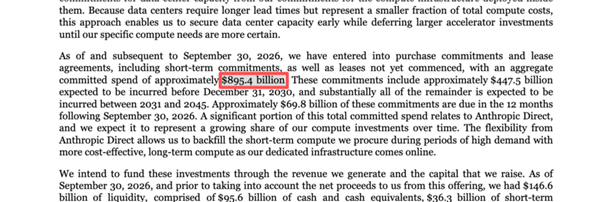
Long-term stress is harder. Taking into account new contracts signed after September 30, Anthropic's total procurement and lease commitments have reached about $895.4 billion, almost all of which are used to buy computing power and rent data centers. The payment period extends to 2045, and about 80% is irrevocable, regardless of the amount used.
Image source: Screenshot of Anthropic prospectus
So, this is not "OpenAI is out of money", but the two families are facing the same thing: the market is no longer willing to pay a higher premium for the future, and we must first see how to get the money back. And the most eager to see this is precisely the seven who just bought Anthropic shares and sold its chips and computing power.
Over the same period, the Nasdaq 100 fell 6.4% in a single day and evaporated $3.2 trillion in market value in a day. Borrowing costs are still rising, and data center construction may encounter new obstacles after the US midterm elections.
Also in November, Sam Altman changed his nickname on X to “Ram Altman.”
The reason is that he complained in the podcast that the global DRAM supply is tight, and only about 5% of the personal computer has a large amount of memory and is actually used. Netizens suggested that he change his name, and he really changed when he replied "OK yeah".
He complained about the real problem. Hash power changed from a cost item of a software company to a rigid cost for the entire industry. Swapping a fixed low-cost subscription for a user won't last long under both cost structures.
In those 14 resets, OpenAI switched to a period of activity, a round of word of mouth, and a public demonstration that the company was also willing to change products for users. But it did not buy the loyalty of the user, the quota was withdrawn, and the dosage disappeared.
The subsidy is linear. The aforementioned engineer told Tiger Sniff that the flywheel is compound interest. Users can use it to improve the product with real data, and the model is stronger and can attract more people to come in.
"Tibo" said that OpenAI graduated from the "reset company", only half correct, the subsidy period is over, and the next comparison is between two companies who can make the price of each token affordable.
The "father-in-law" no longer let the money go. It's not that he doesn't love you anymore, it's that the company behind him wants to calculate whether it's worth it or not.
Source: MyDrivers (Fast Technology). Content is presented with source attribution. Read the original report.
Back to News